
|
Highlights | Interdisciplinary Salon: Child Development and Learning — The Impact of Social Interaction
Time:2026-03-25 Counts:41
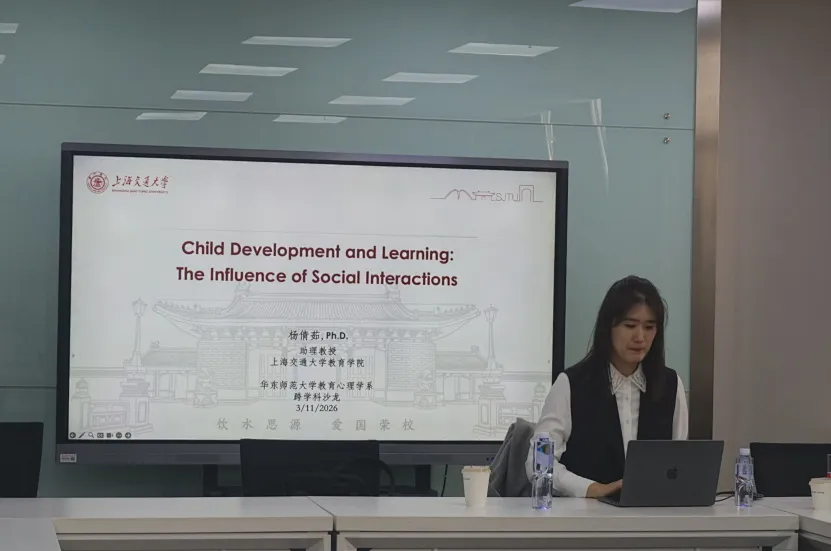
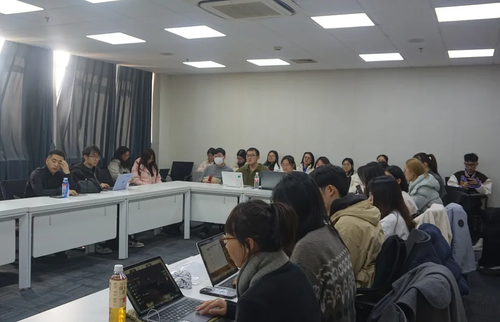
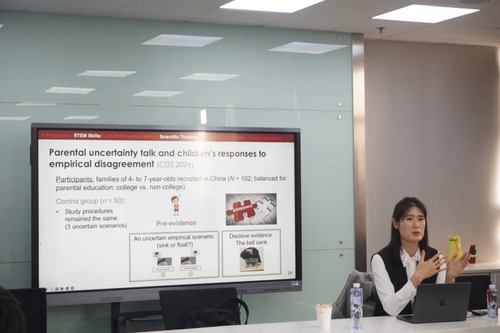
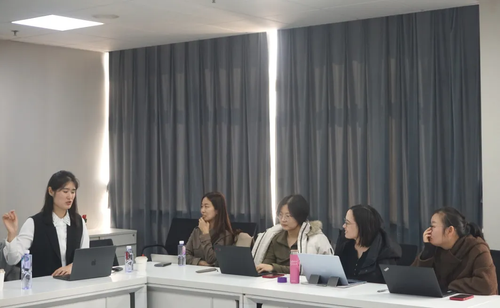
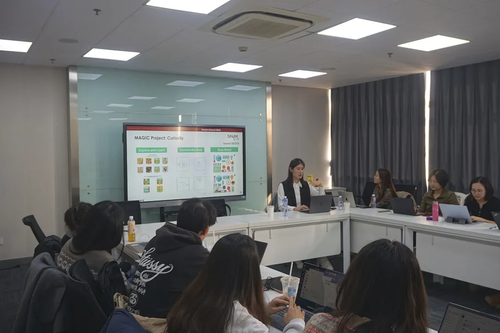
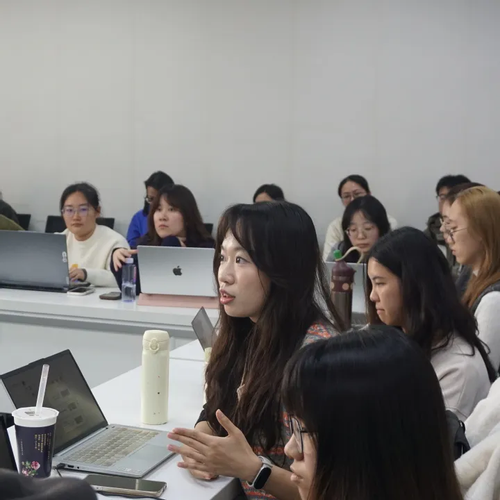
On the afternoon of March 11, 2026, the Department of Educational Psychology at East China Normal University (ECNU) successfully hosted an interdisciplinary salon, featuring Dr. Yang Qianru, Assistant Professor at the School of Education, Shanghai Jiao Tong University, as the keynote speaker. Dr. Yang delivered a lecture titled "How Social Interaction Shapes Children’s Multidomain Cognitive Development". Combining multiple empirical studies, she provided an in-depth analysis of the association between parent-child interaction and children’s mathematical cognition, scientific thinking, and other related abilities. She also shared the application of AI technology in her research and future exploration directions, offering both academic depth and practical implications. The session, chaired by Dr. Zhao Xin from our department, attracted enthusiastic participation from faculty and students.
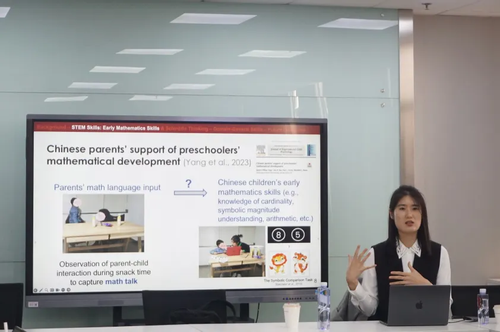
1 Parent-Child Interaction and Children’s STEM Development: Local Exploration and Cross-Cultural Comparison Early childhood (ages 3–12) is a environmentally sensitive period, and parent-child interaction is central to the development of children’s STEM competencies.Addressing sample bias in Western-dominated research, Dr. Yang’s team conducted a study of 90 families with 4–5-year-old children in Jiangsu Province. The results showed a positive correlation between the diversity of mathematical language used by Chinese parents and children’s mathematical ability, highlighting the value of locally grounded research. In a follow-up cross-cultural comparison of Chinese and American preschool families using a block-building task, the team found that parental use of spatial language predicted children’s spatial ability in both countries. Notably, parental autonomy support in Chinese families was associated with children’s nonverbal spatial ability, whereas autonomy support in American families was linked to children’s verbal spatial ability. To overcome the limitations of cross-sectional, single-time-point research, the team will conduct longitudinal tracking and intervention studies in future work to provide causal evidence for the relationship between parent-child interaction and children’s STEM development.
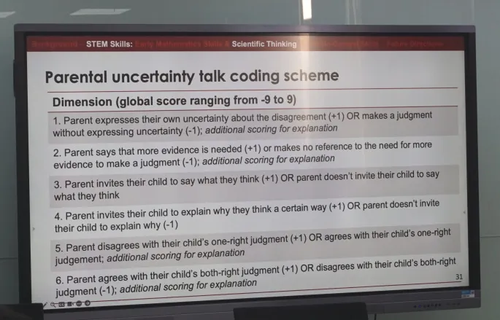
2 Development of Scientific Thinking: The Role of Uncertainty Language and Differences in Family Background The development of scientific thinking constitutes another core focus of this sharing. Dr. Yang’s research team centered on empirical disagreements and conducted a study on children aged 5 to 11 from China and the United States. It was found that children’s scientific thinking matures with age: as children grow older, they become more inclined to consider the plausibility of multiple hypotheses in the absence of evidence, and can make correct judgments once evidence is presented. The team also noted the limitations of the study and stated that future research will adopt novel scientific scenarios in which children have no prior knowledge to refine the experimental design. Regarding individual differences in children’s scientific thinking, the team further explored the influence of parental uncertainty language. A grouped study of families with children aged 4 to 7 revealed that the richness of parental uncertainty language is positively correlated with children’s mature scientific thinking, indicating that parental language in parent-child interactions plays a crucial role in shaping children’s scientific thinking.
3 Parent-Child Interaction and Children’s General Competencies: Assessment of Emotion Regulation and Curiosity Beyond competencies in STEM disciplines, Dr. Yang’s team also examined general foundational abilities that support children’s overall learning, with a focus on how parent-child interaction influences children’s emotion regulation, as well as reflections on and the development of assessment tools for curiosity. In the research on emotion regulation, the team focused on parent-child narrative interactions using a 1-year predictive longitudinal design. The results showed that elaborative utterances by Chinese caregivers were positively associated with children’s emotion regulation competence, in which children’s theory of mind may play a mediating role. An eight-week intervention study with 160 participants is currently underway to establish causal relationships. In the area of curiosity research, Dr. Yang contributed to the development of an assessment tool for curiosity among children aged 3 to 8. She also emphasized that existing tool indicators are grounded in Western cultural contexts and require validation for applicability to Chinese children, with localized adaptation to be advanced in future work.
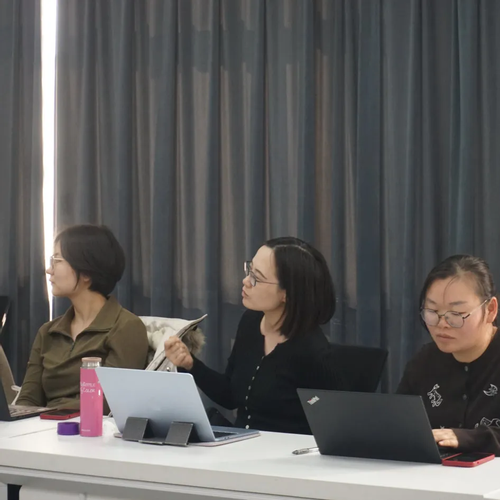
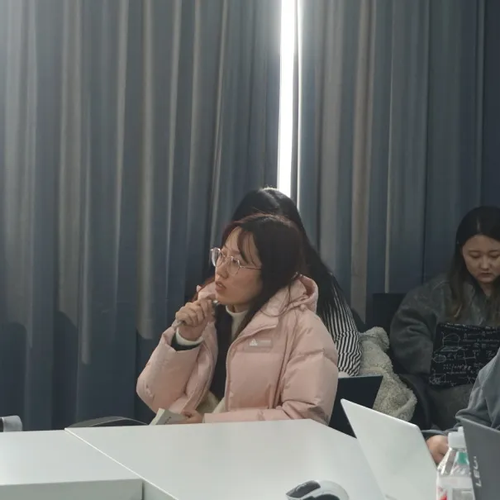
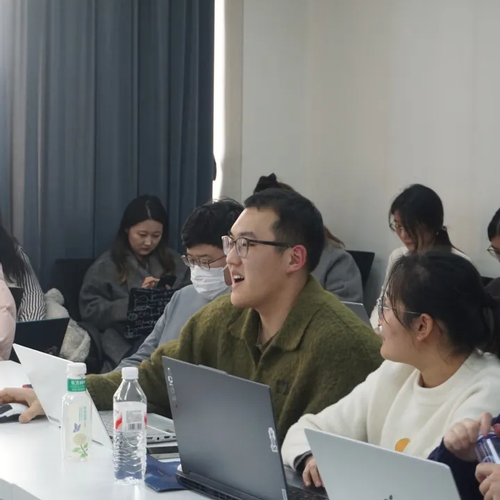
4 Future Research Directions: AI Empowerment and Expansion of Interaction Scenarios Drawing on research practice, Dr. Yang shared two core future directions of his team. The first is AI-empowered research. To address the cumbersome process and insufficient automatic coding in parent-child interaction research, the team has developed a GPT-based text analysis framework to realize automatic coding and annotation of interactive language, reducing manual labor costs. The second is the expansion of interaction scenarios, focusing on early childhood interactions with AI, including unanswered questions such as children’s understanding of AI, the impacts of AI on child development, and its effects on parent-child and teacher-student interactions. Dr. Yang noted that relevant explorations are still in the initial stage, and in-depth research will be conducted to provide scientific evidence for guiding children to use AI companion tools healthily. 5 Interactive Session: Inspiring Reflections on Research and Educational Practice During the Q&A session, participating teachers and students exchanged views with Dr. Yang on key issues including the long-term effectiveness of research, cross-cultural comparisons, and details of behavioral coding.
At this salon, Dr. Yang Qianru drew on a series of empirical studies, cross-cultural comparisons, and localized explorations to clearly elaborate on how parent-child interaction influences children’s development across multiple domains, including STEM competence, scientific thinking, and emotional regulation. She also highlighted the critical roles of family interaction patterns and family background. In addition, Dr. Yang shared the application of AI technologies in her research and outlined directions for future inquiry. This not only addressed limitations in existing research but also provided scientific references for research and practice in child development and education, helping to build a bridge for interdisciplinary exchange and exploration. |
| Contact us | |
|
Department Of Educational Psychology Address : No. 3663, Zhongshan North Road, Shanghai Zip code : 200062 Tel : 86-21-6223078 E-mail : depecnu@163.com |

|
| Copyright 2018 East China Normal University Department Of Educational Psychology . All Rights Reserved | Technical support: Shanghai echao |